Belief in the Creator of the World
elief in the Creator of the World Life
Welcome to our website
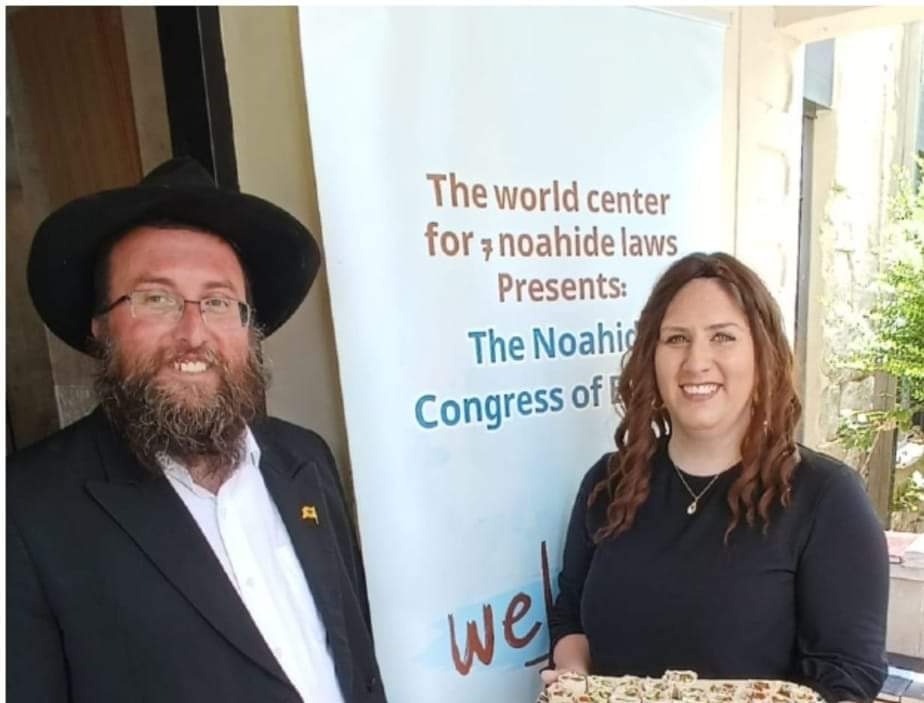
The World Center for the Noahides is led by Rabbi Ben Zion Gagula.
Its purpose is to share the values of Judaism with all people around the world by connecting them to the principles of the Bible — including the Seven Noahide Laws, which belong to everyone who seeks a connection with the Creator.
To be a global center that inspires and awakens humanity to live according to eternal moral foundations rooted in the wisdom of the Torah.
To reach as many people as possible around the world through study, lectures, and spiritual programs — providing each individual with practical tools for a life of meaning and moral values.
To create a global society founded on the eternal values of the Seven Noahide Laws — a world where peace, faith, and mutual responsibility prevail among all human beings.

Guidance on the Seven Noahide Laws, Jewish studies, prayer, group learning, and conferences — all at our Center in Haifa’s historic German Colony.
We offer personal assistance for any question via phone, WhatsApp, or email.

Study Sessions on Jewish Topics and Prayer
elief in the Creator of the World Life

The Torah Our Creator, the Creator of the

he Jewish People Called ‘Children of Israel’ in

he Land of Israel The entire Earth is

he Lubavitcher Rebbe is a messenger of the

The place where eternal wisdom meets the challenges of the present
Welcome!
In the heart of Haifa’s historic German Colony stands the World Center for the Seven Noahide Laws — a spiritual lighthouse for people from all corners of the world.
Our Center is dedicated to promoting the universal values of the Seven Noahide Laws and offering profound spiritual guidance that leads individuals toward a meaningful life based on truth, justice, and kindness.
Our Vision
We believe that life has a purpose — a purpose revealed through the wisdom of the Torah, given by the Creator to the people of Israel at Mount Sinai.
The Torah is not intended for the Jewish people alone; it also reveals the righteous path for all humanity — through the observance of the Seven Noahide Laws, a system of moral and ethical principles binding upon every person on earth.
The Seven Noahide Laws are seven fundamental commandments that God gave to all humanity — not only to the people of Israel.
They form the basic moral and legal code for all mankind.
The commandments are:
Prohibition of idolatry – Worship only the one true Creator.
Prohibition of blasphemy – Do not curse or desecrate God’s Name.
Prohibition of murder – Do not take a life; value the sanctity of human life.
Prohibition of sexual immorality – Avoid forbidden relationships (such as adultery or incest).
Prohibition of theft – Do not steal or take what is not yours.
Prohibition of eating flesh from a living animal – Do not eat meat taken from a living creature.
Establishment of courts of justice – Create a fair legal system to uphold justice and enforce these laws.
The source of these commandments is found in the Talmud (Tractate Sanhedrin 56a), derived from God’s command to Noah and his descendants after the Flood.
The Seven Noahide Laws apply to every person in the world — both Jews and non-Jews.
While the people of Israel received 613 commandments at Mount Sinai, the rest of humanity is obligated only by these seven.
Maimonides (Mishneh Torah, Laws of Kings, ch. 8) writes that anyone who observes these commandments because God commanded them through the Torah and Moses is considered one of the Righteous among the Nations and merits a share in the World to Come.
If one keeps them merely out of moral reasoning or natural logic, they are considered wise — but not among the Righteous of the Nations.
A Noahide who fulfills the Seven Laws remains faithful to divine truth and is regarded as one of the Righteous among the Nations.
The Sages teach (Sanhedrin 105a) that such a person has a share in the World to Come, for they fulfill their human purpose — to recognize the Creator and act justly.
This leads to a moral and just humanity, forming the foundation of Tikkun Olam (world repair), as the prophet Isaiah declared:
“For My house shall be called a house of prayer for all nations.” (Isaiah 56:7)
Yes. A Noahide may voluntarily observe additional mitzvot, such as charity, prayer, or honoring parents.
However, they are not commanded to do so as Jews are.
If performed for the sake of Heaven, these deeds are meritorious, though not equal in obligation to those commanded to Israel.
Certain mitzvot, however — such as observing the Sabbath, wearing tefillin, or affixing a mezuzah — are uniquely for Jews and should not be practiced by Noahides as religious obligations.
All seven are important, but three are viewed as particularly fundamental:
Idolatry – the denial of belief in the one God.
Murder – the destruction of the divine image in humanity.
Sexual immorality – the corruption of family and social sanctity.
These are called the “three grave sins” and form the pillars of moral order. Violating them is considered a very serious transgression even for Noahides.
The commandment of Justice obligates humanity to establish fair and honest legal systems that maintain social order and punish violations of the other six laws.
Every nation must set up courts, judges, and laws based on integrity, fairness, and respect for human rights.
They need not use the Torah’s specific laws, but their systems must align with the ethical and moral values of the Seven Laws.
This law forbids eating any part of an animal while it is still alive.
It teaches compassion toward all living creatures and respect for the sanctity of life.
It was given to Noah after the Flood (Genesis 9:4):
“But flesh with its life, which is its blood, you shall not eat.”
This was the first explicit commandment given to all humanity after creation — a symbol of morality and humanity.
No. The Sabbath and Jewish holidays are unique commandments for the people of Israel, signifying the covenant between God and Israel.
A Noahide who keeps the Sabbath as a religious obligation is considered to be creating a new, unauthorized religion (see Sanhedrin 58b).
However, resting on that day for natural or moral reasons is permissible.
The Seven Noahide Laws form the foundation of universal morality and justice.
They are not narrow religious rules but timeless principles for ethical living — belief in one God, respect for life, family, property, and society.
The Sages view them as the basis for a righteous world where all nations unite in serving God, fulfilling the vision:
“For My house shall be called a house of prayer for all nations.” (Isaiah 56:7)
🍪 אנו משתמשים בעוגיות (Cookies) לשיפור חוויית הגלישה שלך ולהצגת תכנים מותאמים. המשך שימוש באתר מהווה הסכמה לכך. למידע נוסף